// From the team behind TheMap | Order-flow course and simulator

You know your trading rules.
Following them takes practice.

Reading the market is one skill. Managing the decisions you make under pressure is another. 35 days. Daily practice.

You knew what the mistake was before you closed the position. You knew you should not widen the stop. You widened it anyway. The gap is not always between what you know and what is in the books. It is between what you know and what your hand does on the mouse. That is the gap you will practice closing.

Enrollment opens soon $249
One payment | One year from first activation | One computer
Day 12 / 35Discipline score
My entry followed the planYes
I managed the stop as plannedYes
Position size was plannedNo
I respected my daily stopYes
Three out of four75
01 | Why more information is not enough

Watching is not practice, and knowing is not execution.

You have watched the videos. You know what tilt is, what chasing losses looks like and why traders size up at the wrong moment. It still happened this week. It is easier to recall a rule when you are calm than to follow it under pressure. A rule written in advance, rehearsed and reviewed at the end of the day gives you something concrete to work with in the difficult moment.

02 | Inside the course

Everything here is practiced, not just watched.

01
Practice the moments when rules are hardest to follow
Thinking in series, sizing from your current cushion, a personal fear map, real-time resets, losing streaks, pressure near evaluations and payouts, and the line between trading and gambling. Understanding checkpoints test the core material.
02
A 35-day program
One focus each day: a morning task, a rule for the session and an evening question. Lessons are woven into the program. Non-trading days have meaningful work too.
03
Five written protocols
Pre-market, daily stop, after a loss, end of day and pressure situations. Checklists you work through step by step, with completion saved to your account.
04
Decision-room scenarios
Revenge, FOMO, boredom and prop-evaluation pressure. Rehearse the moments that can trigger costly decisions, with timed choices and specific feedback.
05
A journal that reveals patterns
A short entry for each trade: planned entry or not, stop managed as intended, size followed or changed. Over time you have records to review, not just an impression of how you traded.
06
A daily task email
A reminder links to the day's task so you do not have to rely on memory alone. You can unsubscribe at any time.
03 | A look inside

The tools you will actually use.
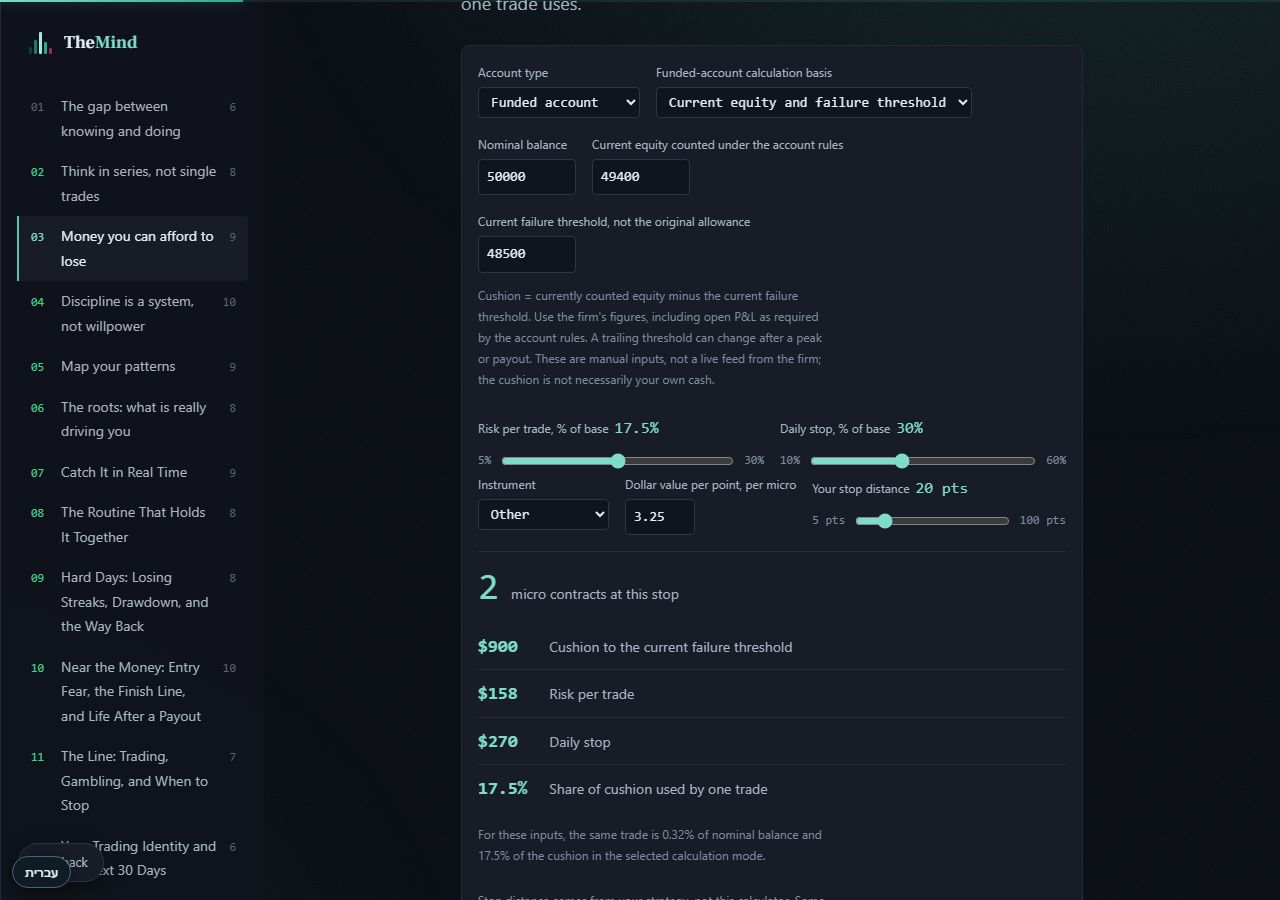
Course lesson: risk calculator using a funded account's numbers
A lesson with a calculator using your own numbers. A prop account labeled $50,000 does not give you $50,000 to lose. Enter its equity and current failure threshold under your firm's rules, and see how much of the remaining cushion one trade risks.
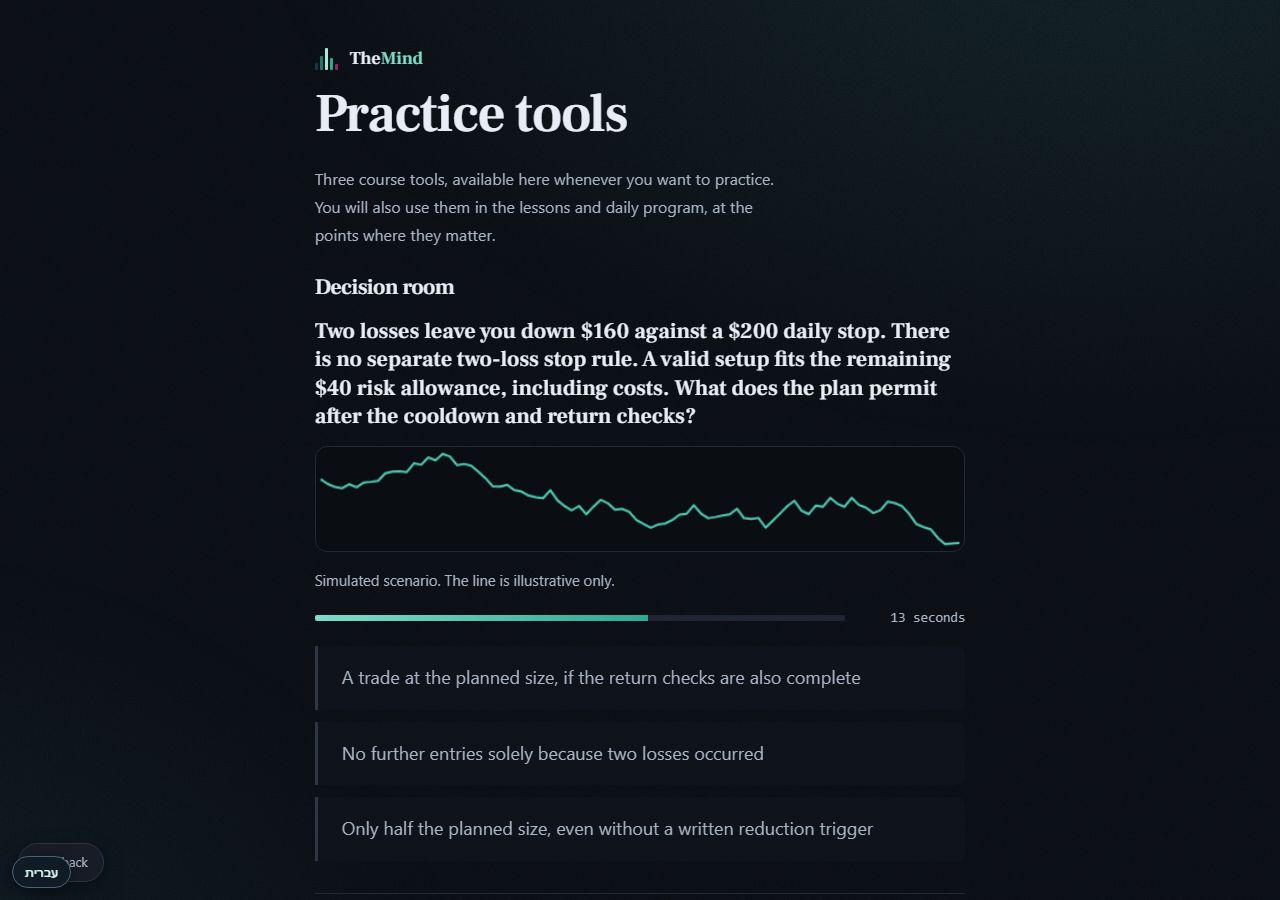
Decision room: a timed scenario with three choices
The decision room. Two losses in a row. Down 160 against a daily stop of 200. A valid setup appears and the clock is running. What do you do?
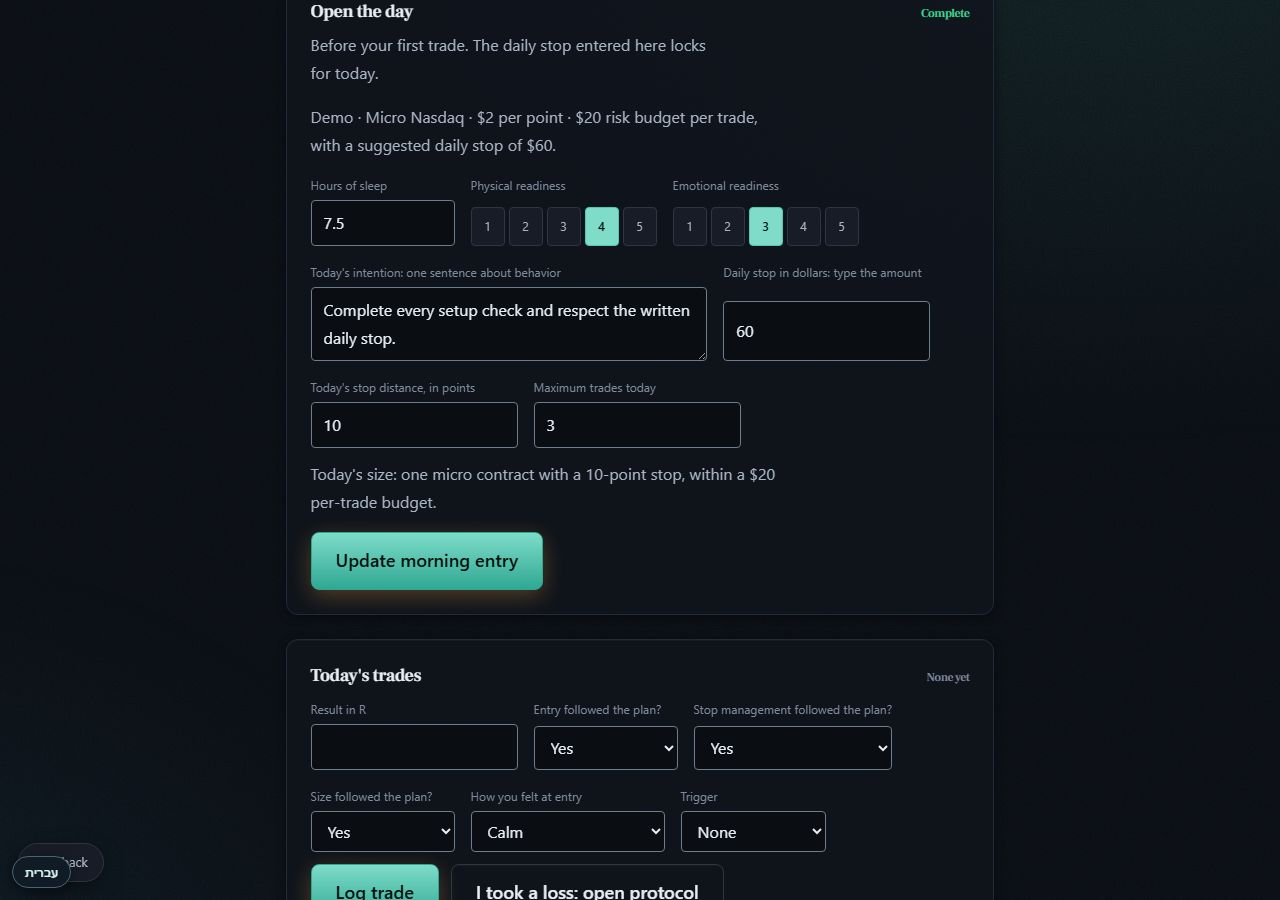
Daily workspace: today's task and pre-market plan
Your daily workspace. Record your intention, readiness and limits before the first trade. Your daily stop locks when confirmed; the rest of your entry stays available for your end-of-day review.
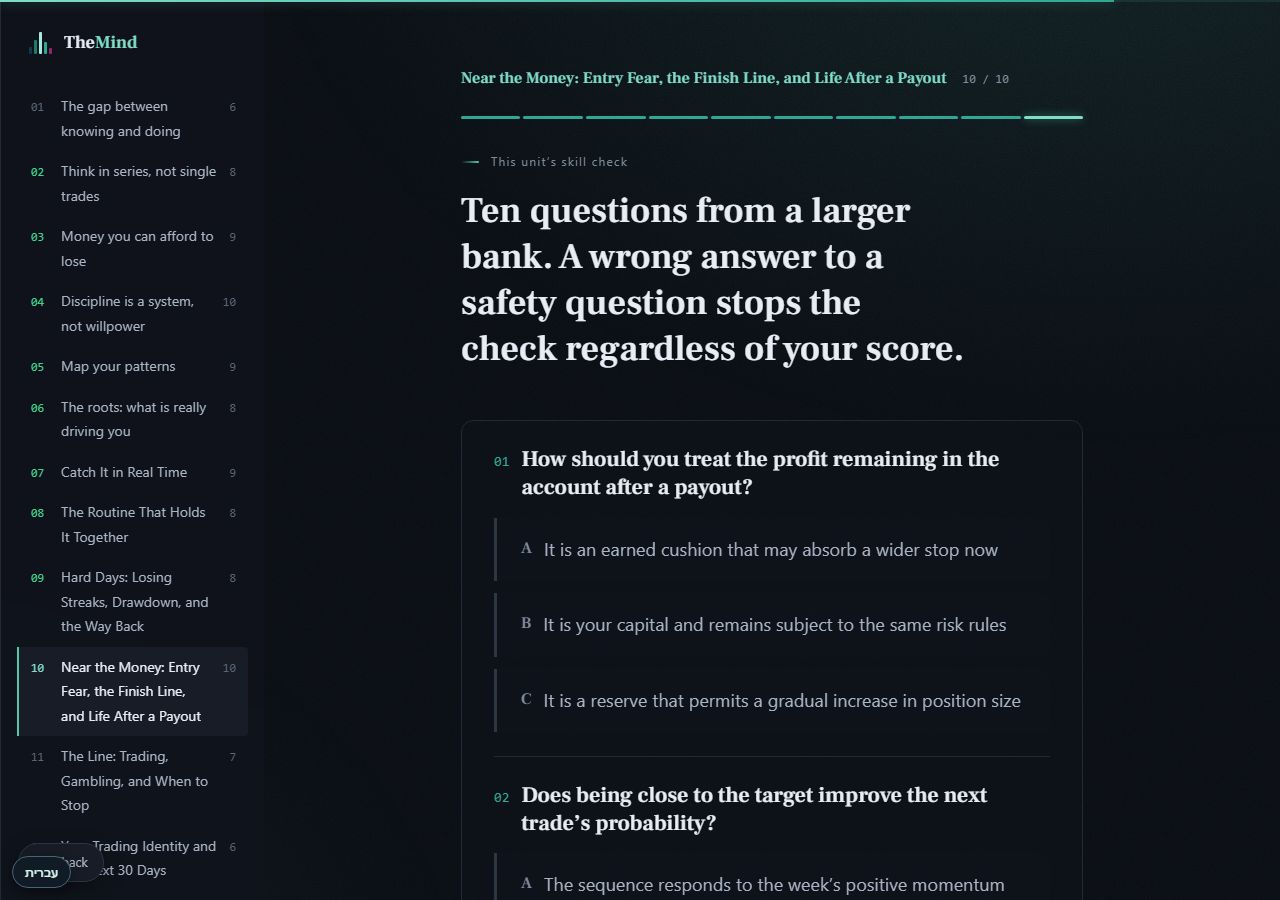
Understanding checkpoint: ten questions sampled from a larger bank
Understanding checkpoints. Ten questions sampled from a larger bank, so a retry uses a fresh set. A missed safety question means the checkpoint is not passed, regardless of the score.

Screenshots show the actual product with demonstration data.

04 | Sources

The ideas have named sources.

Mark Douglas
Probabilistic thinking and accepting risk before entryTrading in the Zone · 2000
Brett Steenbarger
Self-coaching and working through drawdownsThe Daily Trading Coach · 2009
Jared Tendler
Mapping tilt and examining the beliefs behind emotional reactionsThe Mental Game of Trading · 2021
Daniel Kahneman
Loss aversion and the law of small numbersThinking, Fast and Slow · 2011

Alongside research on if-then plans, habit formation and paced breathing. Sources are identified in the course; attribution does not imply endorsement. If you can read these books and consistently apply them on your own, you may not need this course. TheMind turns those ideas into daily tasks, practice and records you can review.

05 | Price

One payment for a full year. No monthly billing.

Compare the format
Monthly trading psychology coachingA recurring monthly fee
A video course you watch onceWithout ongoing tracking
TheMind$249
One payment | One year from first activation
Included
  • The complete course and 35-day practice program
  • The journal, five protocols and decision-room practice
  • Daily task emails throughout the program
  • Your course and journal data saved to your account
  • Course updates during your year of access, at no extra charge
Enrollment opens soon $249
$249 USD for 365 days on one computer, taxes included. Use a participating partner’s coupon for $199 USD, taxes included. One payment, no automatic renewal.
06 | Questions

Before you start.

Who is this not for?

If you want entry strategies or trade signals, this is not that product. It does not promise profits. It is designed for active practice, not passive viewing.

I am not trading live money yet. Is this for me?

Yes. Demo trading is a useful place to rehearse rules without risking real money. The program includes a demo-account mode, alongside prop and personal-account modes.

Why pay for this? Is discipline not just personality?

Written rules, a clear response after a loss and a consistent review routine give you specific behaviors to practice. The course helps you build and rehearse that structure over 35 days.

How much time does it take each day?

Allow roughly 10–20 minutes on most practice days, outside your trading session. Lesson days take longer, and can run to 40 minutes depending on your pace.

I am taking a prop evaluation. Is it relevant?

Yes. The course emphasizes the current distance to your drawdown limit, not just the headline account size. For example, $500 uses 25% of a $2,000 cushion, or 62.5% if only $800 remains. Your firm's actual rules still apply.

How is this related to TheMap?

TheMind is an independent course from the same team. It does not require TheMap's market-reading course, and you can start with either product.

How many computers can I use?

The English plan covers one computer. If you move to another computer, signing in transfers the license. Transfers are limited to once per day.

// TheMind | A system for trading discipline

You know the rule.
Now practice the moment.

Enrollment opens soon $249

Contact

A question about the course or a technical issue? Leave a message and a way to reach you.